

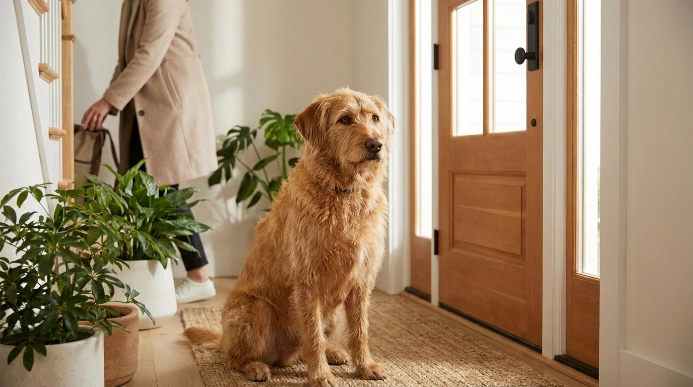
Dog Separation Anxiety: 9 Practical Ways to Help Your Dog Feel Safer Alone
You pick up your keys and your dog immediately starts pacing.
You put on your shoes and they follow you from room to room. Then, minutes after you leave, the barking starts. You may come home to a scratched door, chewed furniture, an accident on the floor, or a dog who greets you as though you have been gone for days.
It is easy to look at this behavior and think your dog is being difficult.
But sometimes the real problem is dog separation anxiety.
A dog experiencing separation-related distress isn’t destroying a door to get revenge for being left behind. The behavior can be a response to genuine fear or anxiety associated with being separated from the person they depend on.
The good news is that there are ways to help. Progress may be gradual, especially when anxiety is severe, but patient training, better routines, appropriate enrichment, and professional support when needed can make being alone much easier for many dogs.
Here is where to start.
What Is Dog Separation Anxiety?
Dog separation anxiety is a behavioral problem in which a dog becomes distressed when separated from a person or people to whom they are strongly attached.
The ASPCA notes that affected dogs may bark, howl, eliminate indoors, chew, dig, attempt to escape, pace, or show anxiety as their owner prepares to leave. Importantly, some of these behaviors can have completely different causes, so destruction or barking alone doesn’t prove that a dog has separation anxiety.
The timing provides an important clue.
If your dog calmly spends the afternoon chewing furniture while you’re sitting nearby, boredom or another behavioral issue could be involved.
If the distress consistently appears when you prepare to leave or shortly after you disappear, separation-related anxiety becomes more plausible.
Common Signs of Dog Separation Anxiety
Dogs don’t all express anxiety in the same way.
Some become extremely vocal. Others become destructive, while some show much quieter signs of stress.
Possible signs include:
- Persistent barking, whining or howling when alone
- Pacing or inability to settle
- Panting or excessive drooling
- Trembling
- Scratching or chewing doors and windows
- Frantic escape attempts
- Urinating or defecating indoors
- Becoming visibly anxious when you pick up keys, shoes or a bag
- Following you intensely before departure
- Refusing food when alone
- Extremely excited greetings when you return
Escape attempts deserve particular attention because dogs can injure their paws, nails or teeth trying to get through doors, windows or confinement.
But remember: context matters more than any single symptom.
Indoor accidents, for example, can result from incomplete house training or medical problems. Barking could be triggered by noises outside. A young dog may chew because chewing is rewarding and they have too much unused energy.
That’s why the first step isn’t automatically treating every unwanted behavior as separation anxiety.
What Causes Separation Anxiety in Dogs?
There isn’t one simple cause that explains every case.
Changes in a dog’s life can sometimes be associated with the development of separation-related problems. These can include a change of family or guardian, a sudden change in schedule, moving to a different home, or the loss or departure of someone in the household.
Imagine a dog whose owner has worked from home for months.
The dog becomes accustomed to having someone nearby throughout the day. Then the owner’s schedule changes and the dog suddenly spends several hours alone.
That’s a substantial change in routine.
Other dogs may struggle after adoption, relocation, changes within the household, or other disruptions.
However, owners shouldn’t assume they somehow “caused” the problem simply by loving or spending time with their dog. Anxiety is more complicated than that, and individual dogs respond differently to similar circumstances.
First: Make Sure Something Else Isn’t Wrong
Before beginning a behavior plan, consider whether another problem could explain what you’re seeing.
This is particularly important when the behavior involves urination, defecation, sudden behavioral changes or physical symptoms.
Medical problems can contribute to house soiling, and medications can sometimes affect urination. The ASPCA recommends ruling out medical causes before assuming inappropriate elimination is caused by separation anxiety.
Behavioral alternatives should also be considered.
The Merck Veterinary Manual notes that other explanations can include incomplete house training, exploratory behavior, outside stimuli, noise-related anxiety and confinement anxiety.
A simple home camera can be extremely useful.
Watch what your dog actually does after you leave.
Do they settle down after two minutes?
Do they react only when the delivery truck arrives?
Or do they begin pacing, panting and vocalizing almost immediately after your departure?
That information can help you—and, when necessary, your veterinarian or behavior professional—better understand the pattern.
1. Start With Very Short Absences
One of the biggest mistakes is expecting an anxious dog to immediately tolerate a long absence.
If your dog becomes distressed after five minutes, repeatedly leaving for three hours doesn’t teach them that being alone is safe.
Instead, training often needs to begin with an absence short enough that the dog doesn’t reach the point of significant distress.
For some dogs that could initially mean minutes.
For more severely affected dogs, it might mean seconds.
You might step behind an interior door briefly, return, and gradually build from there.
The important word is gradually.
Merck’s veterinary guidance recommends simulated absences short enough not to trigger anxiety, with video monitoring useful for checking whether the dog remains below its anxiety threshold.
Don’t rush toward a particular number of minutes. Your dog’s response should determine how quickly training progresses.
2. Make Your Leaving Cues Less Frightening
Dogs are remarkably good at recognizing routines.
Keys jingle.
Laptop closes.
Shoes go on.
Coat appears.
And your dog thinks:
You’re leaving.
For an anxious dog, the stress may therefore begin long before you actually walk through the door.
You can sometimes weaken that prediction by performing normal departure cues without actually leaving.
Pick up your keys and sit down.
Put your shoes on and make coffee.
Grab your bag and then watch television.
The objective is for these signals to stop predicting a long separation every single time.
This doesn’t happen overnight. Dogs learn patterns through repetition, so changing the emotional meaning of those patterns can take time.
3. Build Positive Associations With Alone Time
For mild cases, something your dog genuinely enjoys can help make short periods alone feel more positive.
A food puzzle or stuffed enrichment toy reserved specifically for alone time is one option.
The ASPCA describes counterconditioning as associating being alone with something enjoyable, such as a food-filled toy. However, it also notes an important limitation: highly anxious dogs may be too distressed to eat while their guardian is gone.
That distinction matters.
If your dog normally loves food but completely ignores an irresistible treat after you leave, don’t assume you simply need a tastier snack.
It may be a clue that the level of anxiety is too high for food enrichment alone to solve.
4. Give Your Dog Appropriate Physical Exercise
A dog’s body needs something meaningful to do.
Regular exercise can support overall well-being and may help a dog settle more easily at home.
Depending on your dog’s age, health, breed and individual needs, that might include:
- Walking
- Sniffing walks
- Fetch
- Swimming
- Appropriate running
- Play sessions
- Exploring new environments
But don’t fall into the trap of believing you can simply “exhaust the anxiety out of” a dog.
Exercise can be a valuable part of the routine, but true separation anxiety is not merely excess energy.
Think of exercise as support, not a complete treatment.
5. Exercise Your Dog’s Brain Too
Mental enrichment can be just as valuable as physical activity.
Dogs naturally investigate, sniff, search, chew, lick and solve problems.
Give those behaviors appropriate outlets.
Try activities such as food puzzles, sniffing games, reward-based training, safe chew activities, scatter feeding, or hiding portions of food for your dog to find.
Rotate activities rather than leaving the same toy on the floor every day.
The objective isn’t simply to keep your dog “busy.” It is to create a richer daily routine that gives them appropriate ways to use their body and brain.
6. Keep Departures and Returns Calm
You don’t need to turn leaving home into an emotional ceremony.
A predictable, relaxed routine can be easier for everyone.
Prepare what you need, provide any appropriate enrichment, and leave calmly.
When you return, you can greet your dog without turning every homecoming into the most exciting event of the day.
This doesn’t mean you need to ignore your dog or avoid affection.
The point is simply to make departures and returns feel like normal parts of everyday life, rather than enormous emotional events.
7. Don’t Punish Anxiety
Coming home to a destroyed cushion is frustrating.
But punishment isn’t an appropriate treatment for separation anxiety.
Your dog cannot connect punishment after your return with the emotional state they experienced much earlier in the way people sometimes imagine.
More importantly, anxiety-related destruction, vocalization or house soiling is not a calculated attempt to punish you for leaving.
The ASPCA specifically warns that anxious behaviors are distress responses rather than spite or disobedience, and punishment can make an already anxious dog more upset.
Instead of asking:
“How do I stop this bad behavior?”
ask:
“What is causing my dog to become distressed, and how can I help them feel safer?”
That shift changes the entire approach.
8. Be Careful With Crates
A crate can be a comfortable resting space for a dog who has been properly introduced to it.
But a crate is not automatically a treatment for separation anxiety.
For some dogs, confinement adds another layer of distress.
If your dog frantically bites the crate, attempts to force their way out, drools heavily, persistently howls or risks injuring themselves, forcing longer periods of crate confinement can be dangerous.
The ASPCA notes that crates can help some dogs but cause additional stress and anxiety in others.
Observe the dog in front of you rather than assuming every dog should respond to confinement in the same way.
9. Get Professional Help When Your Dog Needs It
Mild separation-related problems may improve with careful routine changes and gradual training.
Severe cases are different.
Seek professional help when your dog:
- Injures themselves trying to escape
- Experiences intense panic
- Cannot tolerate even very brief separation
- Stops eating when alone
- Shows severe or worsening symptoms
- Has sudden unexplained behavioral changes
- Isn’t improving despite careful training
A veterinarian can first help rule out medical problems.
Depending on the case, assistance may also come from a qualified behavior professional or veterinary behaviorist.
For some dogs with significant separation anxiety, veterinarians may consider medication alongside behavior modification. Merck notes that fluoxetine and clomipramine are FDA-approved in the United States for canine separation anxiety when used with a behavior-modification plan. Medication decisions, however, belong with a veterinarian—not an online article or a pet owner’s guesswork.
How Long Does Dog Separation Anxiety Take to Improve?
There isn’t a universal timeline.
One dog might respond relatively quickly to changes in routine and carefully structured short absences. Another may need a much longer behavior-modification program.
Progress also isn’t always perfectly linear.
A dog might comfortably handle ten minutes one week and struggle after an unexpected change in routine the next.
Measure progress by your dog’s behavior rather than an arbitrary deadline.
Useful signs of improvement can include:
- Settling more quickly
- Less pacing
- Reduced vocalization
- Eating enrichment while alone
- Relaxing when you prepare to leave
- Tolerating gradually longer absences without distress
Small improvements matter.
A Simple Routine to Start With
If your dog has mild symptoms and your veterinarian has no medical concerns, a basic routine might look like this:
Before leaving: Give your dog appropriate exercise and an opportunity to toilet.
A little later: Allow time to settle rather than leaving while your dog is highly excited.
Departure: Keep things calm and provide a safe, high-value enrichment activity if your dog enjoys one.
Training: Practice absences shorter than the point at which your dog becomes distressed.
Return: Come home calmly and allow your dog to settle.
Throughout the week: Include exercise, sniffing, play, enrichment and reward-based training appropriate for your individual dog.
If your dog becomes distressed during the training absences, shorten them rather than continually pushing forward.
Frequently Asked Questions
Can dogs really have separation anxiety?
Yes. Separation-related anxiety and distress are recognized behavioral problems in dogs. Symptoms can include vocalization, destruction, pacing, house soiling and escape attempts associated with being left alone.
Does getting another dog cure separation anxiety?
Not necessarily. If the anxiety centers on separation from a particular person, another dog may not resolve the underlying problem. Adding another pet is a major commitment and shouldn’t be treated as a guaranteed behavioral treatment.
Should I leave the TV on for my dog?
Background sound may be useful for some dogs, but it isn’t a treatment for significant separation anxiety by itself. If it appears to help your dog relax, it can form part of a broader routine.
Will my dog eventually grow out of separation anxiety?
Don’t rely on the problem disappearing on its own. Persistent or severe symptoms deserve attention, particularly when the dog is at risk of injury.
Should I ignore my dog before leaving?
You don’t need to withdraw affection from your dog. The more useful goal is to keep departures predictable and calm while working on the underlying anxiety.
Final Thoughts
Dog separation anxiety can be difficult for both dogs and the people who care for them, but the solution isn’t punishment or simply hoping the dog eventually gets used to being alone.
Start by understanding what actually happens after you leave.
Rule out medical and other behavioral causes. Build alone time gradually. Give your dog appropriate physical and mental enrichment. Keep departures predictable. Avoid pushing them beyond what they can currently tolerate.
Most importantly, pay attention to the severity of the problem.
A mildly unsettled dog and a dog experiencing genuine panic don’t need the same level of intervention.
When symptoms are severe, worsening, or putting your dog at risk, involve your veterinarian or a qualified behavior professional.
Helping an anxious dog become more comfortable alone can take patience, but the goal is worth it: a dog who doesn’t simply endure your absence, but genuinely feels safe when you’re away.
Continue reading more
https://www.aspca.org/pet-care/dog-care/common-dog-behavior-issues/separation-anxiety





[…] difficulty when left alone, for example, can show behaviors far beyond simple barking. Our guide to dog separation anxiety explains what to watch for when anxiety may be contributing to a dog’s […]
[…] Some dogs also struggle when separated from their owners. If trembling occurs around departures or accompanies destructive behavior, excessive vocalization, pacing, or attempts to escape, read our guide to dog separation anxiety. […]
[…] vocalization, or distress when the dog is left alone, consider the broader emotional picture. Our dog separation anxiety guide explains how anxiety can produce a cluster of behaviors rather than one isolated […]
Comments are closed.