

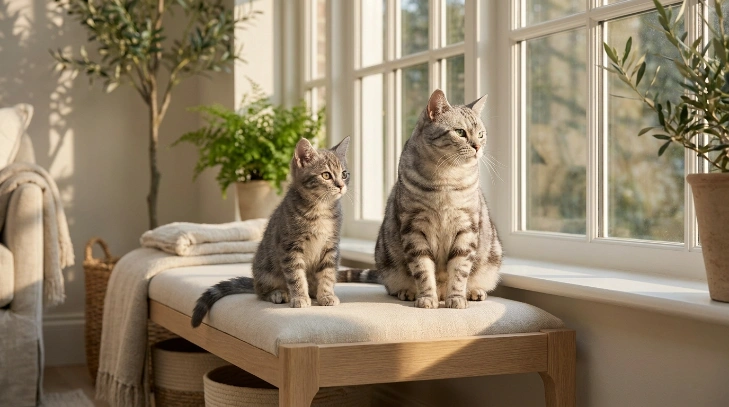
Most domestic cats reach close to adult size around 12 months, although many continue filling out until roughly 12 to 18 months. Breed, sex, genetics, nutrition and health can all influence the answer to when do cats stop growing.
Knowing the growth stage helps with feeding and weight monitoring. Our kitten feeding guide explains how appropriate nutrition supports development.
1. Most Cats Approach Adult Size Around 12 to 18 Months
The first year contains most of the dramatic growth. Veterinary guidance commonly places typical adult size around 12 to 18 months, though individuals vary. A cat may stop getting taller while still developing muscle and broader adult proportions.
2. Kittenhood Is the Fastest Growth Period
Kittens grow rapidly during their first months as bones lengthen and muscles develop. This is why they need food formulated for growth rather than simply smaller servings of adult food.
The Association of American Feed Control Officials explains that nutritional adequacy statements identify foods formulated for life stages including growth. A complete and balanced kitten diet helps provide appropriate nutrients during this demanding stage.
3. Large Breeds Can Keep Growing Longer
Breed is a major reason healthy cats follow different timelines. A domestic shorthair may look adult-sized around its first birthday, while large breeds such as Maine Coons and Norwegian Forest Cats can continue developing for two years or longer. Genetics strongly influence eventual frame and weight.
4. Male and Female Cats May Develop Differently
Male cats are often larger-framed than females of the same breed, although individual variation is substantial. PetMD notes that females commonly finish growing around 10 to 12 months while some males continue toward 18 months. These are guidelines, not deadlines.
5. Nutrition Supports Growth, but More Food Is Not Better
Growing kittens need sufficient calories, protein, essential fatty acids, vitamins and minerals, but healthy growth should not mean maximizing weight. Overfeeding encourages excess body fat while an inadequate diet can interfere with development.
Appetite changes deserve attention. If an older kitten or adult suddenly refuses meals, our guide explaining why a cat may stop eating covers warning signs. Hydration also matters, and our guide to how much water a cat should drink explains how diet and health influence drinking.
6. How to Tell When Your Cat Has Stopped Growing
Track weight regularly using the same scale when possible. If height, length and healthy body weight remain relatively stable for several months, your cat is probably approaching physical maturity. Your veterinarian can assess body condition and distinguish healthy development from excess weight gain.
7. Slow Growth Can Sometimes Signal a Problem
Normal size varies, but poor growth deserves investigation when accompanied by persistent diarrhea, repeated vomiting, lethargy, poor coat quality, weakness or loss of appetite. Parasites, gastrointestinal disease, infections and inadequate nutrition are among the possibilities a veterinarian may consider.
If loose stools accompany poor growth, our cat diarrhea guide explains important warning signs. Repeated vomiting should also not simply be dismissed as growing up; our cat vomiting guide covers common causes and red flags.
Cat Growth Timeline
Birth to 3 months
This is a period of extremely rapid physical development. Kittens transition toward solid food, exploration and greater coordination.
3 to 6 months
Growth remains rapid. Bodies lengthen, adult teeth emerge and kittens can look lanky as different parts develop.
6 to 12 months
Growth generally slows and many cats approach adult height and length.
12 to 18 months
Many cats finish remaining development and fill out through the shoulders and body. Large breeds may remain immature.
Beyond 18 months
Most ordinary domestic cats are physically mature, but some large breeds continue developing considerably longer.
When Should You Switch to Adult Cat Food?
For many cats, transition occurs around the first birthday, but timing depends on growth, body condition, breed and health. Do not switch only because your kitten looks large. Ask your veterinarian if you are uncertain, especially with large breeds or kittens gaining too much or too little weight.
Does Spaying or Neutering Stop Growth?
Spaying or neutering does not simply switch growth off. Hormones influence skeletal maturation, but genetics and nutrition remain important determinants of adult size. Calorie requirements can change after neutering, so continued weight gain should not automatically be interpreted as growth.
Frequently Asked Questions
At what age are cats fully grown?
Most are close to adult size around 12 months and may continue filling out until roughly 12 to 18 months. Large breeds can develop longer.
Do cats grow after one year?
Some do. A cat may continue developing muscle and adult proportions after its first birthday, especially if it belongs to a large breed.
How can I tell how big my kitten will get?
Breed, sex, parental size and growth pattern provide clues, but no formula is perfect. Regular weighing and veterinary examinations are more useful for tracking healthy development.
Can poor nutrition affect growth?
Yes. Inadequate nutrition can interfere with normal development. Kittens should receive a complete and balanced diet formulated for growth unless a veterinarian recommends otherwise.
When should I worry?
Seek veterinary advice for failure to gain weight appropriately, weight loss, persistent diarrhea, repeated vomiting, weakness, poor appetite or other signs of illness.
PetCareRoutine Perspective
For most cats, the answer to when do cats stop growing is around their first year, with some development continuing through 12 to 18 months. Breed, sex and genetics can substantially change that timeline.
Rather than chasing a particular weight, track steady development, feed a complete and balanced growth diet and use routine veterinary visits to assess body condition. Healthy growth is not about becoming big quickly; it is about reaching the adult size that is right for the individual cat.






[…] usually becomes more similar to that of an adult cat. If you are raising a young cat, our guide on when cats stop growing explains how development changes through kittenhood and when most cats reach adult […]
Comments are closed.