
Cats spend plenty of time cleaning themselves, but even excellent self-groomers can benefit from a little help. Learning how to groom a cat gives you a practical way to control loose fur, prevent painful mats, maintain claws, and notice changes in the skin or coat before they become easy to overlook.
The goal is not to make your cat look freshly styled every day. Good grooming protects comfort and health while respecting normal feline behavior. The right routine depends on coat length, age, mobility, lifestyle, and how comfortable your cat is with handling.
Cornell University’s Feline Health Center notes that regular brushing can keep the coat clean and sleek while helping owners monitor the skin for parasites and signs of disease. VCA similarly advises that all cats benefit from regular brushing, with long, silky, or curly coats often requiring much more frequent attention.
Here is a practical routine you can adapt to your own cat.
1. Make Brushing the Foundation of Cat Grooming
If you do only one grooming task consistently, make it brushing.
Brushing removes loose hair, dead skin, dirt, and small debris before much of it is swallowed during self-grooming. It also gives you an opportunity to feel the body and inspect areas normally hidden by fur.
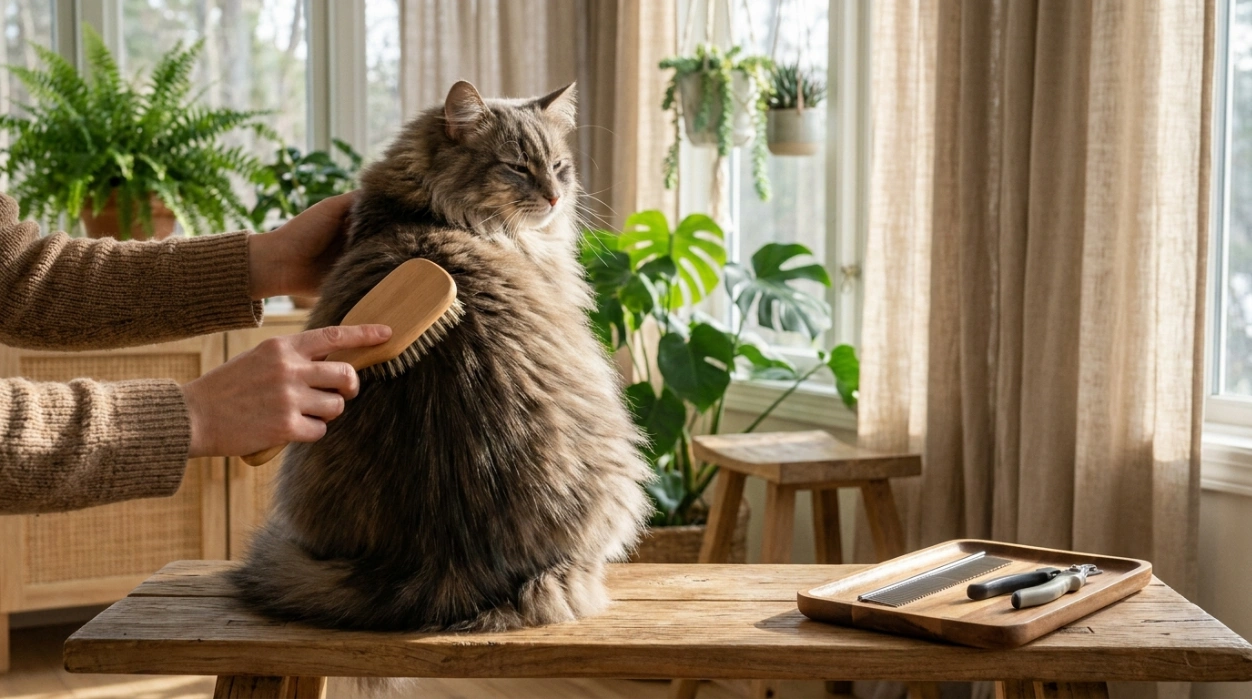
For short-haired cats, a gentle bristle brush, rubber grooming tool, or suitable comb may be enough. Medium- and long-haired cats often benefit from a longer-toothed comb that can reach farther through the coat without aggressively pulling the skin.
Brush in the natural direction of hair growth and use light pressure. More force does not mean better grooming. If the tool repeatedly catches, investigate the area rather than dragging it through.
Frequency depends heavily on coat type. Some short-haired cats may need brushing only once or twice each week, while long, silky, or curly coats may need daily attention to remain free of tangles. VCA specifically recommends frequent inspection around areas where mats commonly develop, including behind the ears, under the legs, and around the groin.
Regular brushing also reduces the amount of loose hair a cat swallows. That can be especially useful for long-haired cats that are more prone to hairball problems.
2. Prevent Mats Instead of Fighting Them Later
A mat is not simply messy fur. As tangled hair tightens, it can pull against the skin whenever the cat walks, stretches, or changes position. Severe matting may conceal irritated skin, wounds, parasites, or moisture underneath.
Check high-friction areas regularly: behind the ears, beneath the front legs, around the chest, belly, groin, and back legs.
If you find a very small loose tangle, hold the fur near the skin so you are not pulling directly on your cat, then gently work from the outer end of the tangle rather than attacking the tightest section first.
Stop if the mat is tight against the skin.
Do not slide ordinary scissors underneath a dense mat. Feline skin is thin and can be pulled upward into tangled fur, making accidental cuts surprisingly easy. VCA advises against using scissors for mats because of this risk.
Severe mats are safer in the hands of a veterinarian or an experienced cat groomer. In some cases clipping is more humane than prolonged pulling and combing.
A few minutes of preventive brushing is far easier on your cat than removing a painful mat later.
3. Bathe Your Cat Only When It Is Actually Needed
Bathing is often the first thing people imagine when they hear “pet grooming,” but for most healthy cats it is not the main event.
Cats are highly effective self-groomers and generally do not need routine baths on a dog-like schedule. VCA advises bathing cats as needed rather than automatically.
A bath may be appropriate when a cat is genuinely dirty, has a safe but difficult-to-remove substance in the coat, cannot groom effectively, or requires a medicated bath prescribed by a veterinarian.
If bathing is necessary, prepare everything before bringing the cat to the bathing area. Use comfortably warm water, a secure non-slip surface, towels, and a shampoo specifically formulated for cats. Keep water away from the eyes and ears, rinse thoroughly, and keep your cat warm while drying.
Never assume a human shampoo, essential-oil product, or strongly fragranced grooming product is automatically safe for cats.
More importantly, pay attention if a previously tidy cat suddenly becomes greasy, dirty, or unkempt. Older cats can groom less effectively, and Cornell notes that senior cats may develop matting, odor, and inflammation as self-grooming declines. Pain, obesity, arthritis, dental disease, or other illness can also interfere with grooming.
A sudden change in coat care can therefore be a health clue rather than a bathing problem.
4. Keep Claws Comfortable With Regular Checks
Claw maintenance belongs in a complete how to groom a cat routine, particularly for indoor and older cats.
VCA notes that indoor cats commonly benefit from regular nail trims and gives a general interval of roughly every two to four weeks, although the right timing depends on the individual cat. Older cats may need additional help because reduced activity can allow claws to become overgrown.
To inspect a claw, gently hold the paw and press the toe pad so the claw extends. Most light-colored cat claws make the pink quick easy to see. The quick contains nerves and blood vessels, so trim only the sharp translucent hooked tip and leave a comfortable margin.
Use sharp pet nail clippers and remove only a small amount.
Do not make completing all four paws the measure of success. One calm paw—or even one calmly trimmed claw—is more productive than restraining a frightened cat until the entire job is finished.
VCA recommends gradual handling and positive associations, especially for cats that dislike paw handling.
Scratching posts are still necessary. Scratching is normal behavior and should not be replaced by nail trimming.
5. Inspect the Ears, Eyes and Paws While You Groom
Grooming time is an opportunity to notice what is normal for your cat.
Look at the visible parts of the ears without inserting cotton swabs deep into the ear canal. Healthy ears should not suddenly develop heavy discharge, marked redness, swelling, a strong unpleasant odor, or obvious pain.
Persistent head shaking, ear scratching, dark debris, or sensitivity can accompany ear mites, inflammation, infection, or other problems. Repeatedly cleaning the ear without knowing the cause can delay appropriate treatment.
Also glance at the eyes for unusual discharge or irritation and check the paws for swelling, damaged claws, debris, or tenderness.
If your cat repeatedly licks one paw or suddenly resists having a particular area touched, do not force the grooming session. Investigate why that spot has become sensitive.
Grooming works best as observation, not home diagnosis.
6. Turn Grooming Into a Simple Health Check
One underrated benefit of regular grooming is familiarity. When you know how your cat normally feels under your hands, unusual changes become easier to notice.
As you brush, watch for:
- New lumps or swelling
- Red, flaky, or irritated skin
- Scabs or sores
- Unexplained bald patches
- Fleas, ticks, or flea dirt
- Unusual dandruff
- A sudden greasy or dull coat
- Pain when touched
- Areas your cat no longer grooms
- Excessive licking or chewing
Cornell specifically points out that brushing helps owners monitor the skin for parasites and signs of disease. That does not mean every bump or patch of dandruff is an emergency, but persistent or significant changes deserve attention.
Senior cats deserve particular care. Cornell reports that older cats often groom themselves less effectively and may develop matting as a result. Their claws can also become thick and overgrown.
If a previously well-groomed cat suddenly stops caring for the coat, consider it information. A veterinary examination may be more useful than simply increasing the number of grooming sessions.
7. Make Grooming Calm and Cooperative
The perfect brush is not much use if your cat runs the moment you pick it up.
Start grooming when your cat is relaxed rather than highly excited. Let them investigate the tool. Begin with areas they already enjoy having touched, such as the cheeks, shoulders, or upper back.
Keep early sessions deliberately short. A few comfortable brush strokes followed by a reward can build a better long-term routine than holding a cat down for fifteen stressful minutes.
Watch body language. Tail twitching, flattened or rotated ears, dilated pupils, a tense body, repeated attempts to leave, growling, or swatting tell you that the session needs to slow down or stop.
Never punish resistance.
If your cat dislikes paw handling, start by briefly touching a leg and rewarding calm behavior. Over several sessions, progress toward the paw, toes, and eventually the clipper. The same principle can be used with brushing and other grooming tools.
Kittens are often easier to introduce to grooming because handling can become an ordinary part of life before a difficult mat or overgrown claw creates urgency. Cornell also recommends starting brushing and nail-care routines early when possible.
How Often Should You Groom a Cat?
There is no universal schedule.
A short-haired healthy adult may need relatively modest brushing, while a Persian or another long-coated cat may require daily coat care. Shedding, lifestyle, age, body condition, and health can all change the amount of help needed.
As a practical starting point, inspect the coat frequently and brush short coats at least regularly enough that loose hair and tangles do not accumulate. Long, silky, or curly coats often need daily brushing. Check claws every few weeks rather than waiting until they are obviously overgrown.
Senior, overweight, or mobility-limited cats may need extra assistance reaching the back, hips, and other areas.
Do Indoor Cats Still Need Grooming?
Absolutely.
Indoor living does not stop shedding, mat formation, claw growth, or skin changes. In fact, indoor cats may need more direct claw maintenance because their lifestyles may provide less natural wear.
They also shed into the home throughout the year, making regular brushing useful for both the cat and the household.
Grooming is therefore not an outdoor-versus-indoor issue. It is part of routine care based on the individual animal.
What If Your Cat Hates Being Groomed?
First ask whether the reaction is behavioral or physical.
If a cat that previously enjoyed brushing suddenly growls when the lower back is touched, pain may be involved. Tight mats, irritated skin, wounds, arthritis, or other medical problems can make ordinary grooming uncomfortable.
If there is no apparent medical problem and your cat simply lacks grooming experience, rebuild the process gradually. Pair the sight of the brush with something pleasant. Touch the coat once. Reward. End the session. Progress slowly over days rather than forcing a complete groom.
If safe handling is impossible, an experienced cat groomer or veterinary team is the better option.
When Does a Grooming Problem Need a Veterinarian?
Contact your veterinarian when grooming reveals persistent skin redness, sores, unexplained hair loss, parasites you cannot control, painful or infected-looking ears, a damaged claw, severe matting associated with skin problems, or a sudden decline in self-grooming.
Also seek help when your cat seems painful, unusually lethargic, or has other symptoms alongside a deteriorating coat.
A grooming change can sometimes be the first visible sign that your cat does not feel well.
Frequently Asked Questions
Do cats need owners to groom them?
Yes, although the amount of help varies. Regular brushing removes loose hair and helps detect coat or skin changes. Long-haired, senior, overweight, and mobility-limited cats may need substantially more assistance.
How often should I brush my cat?
Short-haired cats generally need less frequent brushing, while long, silky, or curly coats may require daily care to prevent tangles and mats. Adjust frequency according to your cat’s actual coat condition.
Should I bathe my cat regularly?
Usually not. Most healthy cats are effective self-groomers. Bathe when there is a specific need, such as significant dirt or veterinarian-directed treatment.
Can I cut a mat out with scissors?
Avoid scissors around tight mats. Cat skin is thin and can be pulled into tangled fur, creating a serious risk of accidental cuts. Seek professional help for dense or skin-tight matting.
How often should indoor cats have their nails trimmed?
VCA gives a general range of every two to four weeks for indoor cats, but individual claw growth and activity differ. Regular inspection is more useful than blindly following a calendar.
PetCareRoutine Perspective
Learning how to groom a cat is less about creating a complicated beauty routine and more about building a few useful habits.
Brush before mats develop. Check claws before they become overgrown. Bathe only when there is a real reason. Use grooming sessions to learn what your cat’s skin, coat, paws, and body normally look and feel like.
Most importantly, protect your cat’s sense of safety. A calm three-minute session repeated regularly is more valuable than an occasional marathon grooming session that ends in fear.
When something suddenly changes—whether it is the coat, grooming behavior, skin, or tolerance for touch—do not automatically assume the solution is another grooming product. Sometimes the most important thing grooming does is tell you that your cat needs a closer look.
Related: kitten feeding guide · how much water should a cat drink · cat vomiting and when to call a vet
Sources: https://vcahospitals.com/flannery/know-your-pet/grooming-and-coat-care-for-your-cat?