

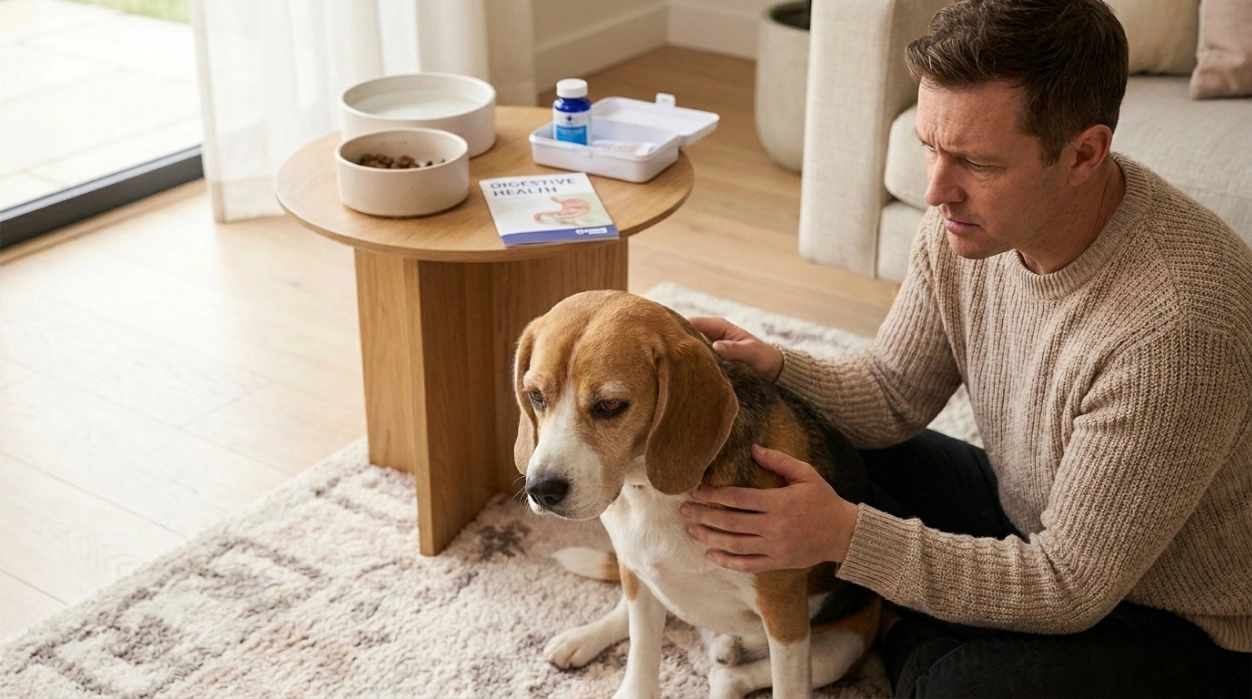
Dog Diarrhea: 7 Common Causes, What to Do, and When to Worry
You take your dog outside expecting a normal bathroom break, only to discover their stool is suddenly loose or watery.
It’s unpleasant, but it’s also something almost every dog owner encounters eventually.
The difficult part is knowing whether you should simply monitor your dog or call the veterinarian.
Dog diarrhea is a symptom, not a disease. It can happen because your dog ate something unusual, changed foods too quickly, became stressed, picked up a parasite, or developed a more serious health problem.
Many mild cases resolve without major intervention, particularly when an otherwise healthy adult dog remains bright, active, eating, and drinking normally. But diarrhea can also accompany illnesses that require prompt veterinary care.
According to Cornell University’s College of Veterinary Medicine, veterinary attention is recommended when diarrhea is accompanied by problems such as vomiting, lethargy, loss of appetite, black or tarry stool, or when it doesn’t resolve within roughly 48–72 hours.
So instead of panicking at the first loose stool—or ignoring diarrhea for days—here’s how to understand what may be happening.
What Exactly Is Dog Diarrhea?
Diarrhea means your dog’s stool contains more water than normal and is usually softer, less formed, or completely liquid.
It may happen once or repeatedly.
You might see:
- Soft but somewhat formed stool
- Pudding-like stool
- Completely watery diarrhea
- Mucus
- Changes in stool color
- Increased frequency
- Urgency to go outside
- Accidents indoors
One episode in an otherwise normal adult dog is very different from repeated watery diarrhea in a lethargic puppy.
That’s why you should look at your whole dog, not just what’s on the ground.
Are they playing normally?
Are they drinking?
Do they want food?
Are they vomiting?
Does their abdomen appear painful?
Is there blood?
The answers help determine how concerning the situation may be.
1. Your Dog Ate Something They Shouldn’t
Dogs aren’t famous for making sophisticated dietary decisions.
A dropped piece of greasy food, leftovers from the trash, spoiled food, or too many treats can quickly upset a dog’s digestive system.
Veterinarians sometimes call this dietary indiscretion.
For many dogs, the resulting diarrhea is temporary. But what the dog ate matters.
Eating a small amount of unfamiliar but non-toxic food isn’t equivalent to swallowing a foreign object, medication, toxic substance, or large amount of high-fat food.
If you know or suspect your dog swallowed something potentially toxic or an object that could cause an obstruction, don’t wait for diarrhea to resolve before seeking professional advice.
And don’t deliberately induce vomiting unless a veterinarian or appropriate poison professional instructs you to do so.
2. Their Food Changed Too Quickly
You find a better dog food and switch immediately.
Two days later, your dog has diarrhea.
The new food isn’t necessarily bad.
The speed of the transition may be the problem.
A dog’s gastrointestinal system can need time to adjust to dietary changes. Cornell recommends transitioning diets gradually and notes that dogs with sensitive stomachs may require an even slower change.
Instead of suddenly replacing the entire bowl, gradually increasing the proportion of new food gives the digestive system time to adapt.
This also makes it easier to notice whether your dog genuinely doesn’t tolerate the new diet.
If diarrhea starts immediately after a food change, contact your veterinarian if it’s persistent or accompanied by other symptoms rather than repeatedly switching to yet another food.
Constant diet changes can make identifying the actual problem harder.
3. Stress
Dogs can get stress-related digestive upset too.
Potential triggers include:
- Boarding
- Traveling
- Moving house
- A veterinary visit
- Changes in household routine
- New animals
- Unfamiliar environments
- Exciting or stressful events
A dog may otherwise seem healthy but develop temporary loose stool around one of these events.
That doesn’t mean every episode following stress should automatically be dismissed as “nerves.”
If diarrhea becomes severe, continues, or occurs with vomiting, weakness, pain, poor appetite, or other concerning symptoms, another explanation needs to be considered.
4. Intestinal Parasites
Parasites are another reason a dog may develop diarrhea.
Examples include Giardia and coccidia, among others.
Cornell’s veterinary guidance on Giardia explains that dogs can become infected by ingesting Giardia from feces-contaminated water, soil, food, or objects. Some infected dogs show no obvious illness, while younger dogs and those with weakened immune systems are more likely to develop symptoms.
This is one reason your veterinarian may request a fresh stool sample when investigating diarrhea.
Don’t assume that a dog looks too clean or healthy to have an intestinal parasite.
Exposure can happen outdoors, around contaminated feces, through contaminated environments, or through other routes depending on the parasite.
Puppies deserve particular attention because diarrhea and fluid loss can affect them more quickly than a healthy adult dog.
5. Infection
Viral and bacterial illnesses can also cause diarrhea.
One particularly serious concern in puppies and inadequately vaccinated dogs is canine parvovirus.
Cornell describes parvovirus as a highly contagious and dangerous disease that particularly affects young, unvaccinated dogs. Signs can progress from lethargy and reduced appetite to vomiting, diarrhea—sometimes with blood or mucus—weakness and dehydration.
This is not something to treat with a home remedy.
A puppy with vomiting and diarrhea, particularly one that isn’t fully vaccinated, should receive prompt veterinary attention.
Other infections can cause gastrointestinal symptoms as well, which is why diagnosis based solely on stool appearance isn’t reliable.
6. Food Intolerance or Other Dietary Problems
Sometimes the issue isn’t that the food changed too quickly.
A particular ingredient or diet may genuinely not agree with the dog.
Chronic digestive problems can also involve conditions more complicated than simple intolerance.
If your dog repeatedly develops diarrhea despite eating the same diet, don’t keep solving each episode with temporary home care indefinitely.
Recurring symptoms warrant investigation.
Your veterinarian may want to know:
- What food your dog eats
- Every treat they receive
- Table scraps
- Supplements
- Chews
- Recent dietary changes
- How long the diarrhea has been occurring
- Whether vomiting or weight loss is present
Be accurate.
That tiny piece of cheese every evening still counts.
So does food stolen from another pet’s bowl.
7. An Underlying Medical Problem
Persistent dog diarrhea can sometimes be a sign of disease elsewhere in the body or a chronic gastrointestinal disorder.
Potential causes veterinarians may investigate include inflammatory gastrointestinal disease, pancreatic disorders, liver disease, endocrine disease, and other conditions.
For example, Cornell describes canine inflammatory bowel disease as a chronic gastrointestinal condition in which signs can include diarrhea, vomiting, changes in appetite, flatulence, and weight loss. Diagnosis generally involves ruling out other possible causes first.
The important lesson isn’t to assume your dog has one of these conditions after two loose stools.
It’s the opposite:
Don’t assume persistent diarrhea is always just a sensitive stomach.
Repeated symptoms deserve an explanation.
What Can You Do at Home for Mild Dog Diarrhea?
If your dog is an otherwise healthy adult, has experienced a mild episode, and is behaving completely normally, your veterinarian may recommend conservative management.
But home care isn’t appropriate for every dog or every case.
Keep Fresh Water Available
Diarrhea causes fluid loss.
Your dog should have access to fresh drinking water unless your veterinarian specifically tells you otherwise.
Diarrhea combined with vomiting increases concern about dehydration.
Keep Food Simple
Veterinarians may sometimes recommend a short-term highly digestible diet for uncomplicated diarrhea.
Cornell discusses temporary bland options such as plain cooked lean meat with white rice for mild cases, while also emphasizing that such homemade bland diets are not nutritionally balanced for long-term feeding.
That’s an important distinction.
A temporary digestive diet isn’t a permanent nutritional plan.
If your dog regularly needs chicken and rice just to maintain normal stool, the underlying problem deserves veterinary investigation.
Stop the Extras
Now isn’t the time for:
- Rich treats
- Fatty table scraps
- New chews
- Unfamiliar foods
- Large amounts of human food
Give the digestive system some consistency.
Take Your Dog Outside More Often
Diarrhea creates urgency.
A perfectly house-trained dog may suddenly need to go outside much more frequently.
Don’t punish accidents.
Give your dog additional bathroom opportunities while their digestive system is unsettled.
What Should You NOT Give a Dog With Diarrhea?
One of the most important rules is:
Don’t automatically give your dog human anti-diarrheal medication.
Cornell specifically advises owners not to use products such as Pepto-Bismol or Imodium unless directed by a veterinarian because these medications may be harmful to some dogs or interact with other medicines.
Likewise, avoid:
- Leftover prescription medication
- Another pet’s medicine
- Random antibiotics
- Unverified supplements
- Essential oils
- Internet “detox” remedies
Diarrhea has many causes.
Suppressing the symptom without understanding the cause isn’t always helpful and can sometimes complicate the situation.
What Does the Color of Dog Diarrhea Mean?
Color can provide information, but don’t attempt to diagnose your dog solely from a stool-color chart.
Brown: Often the expected color even when consistency is abnormal.
Yellow: Can occur for various digestive reasons and isn’t diagnostic by itself.
Green: May sometimes reflect something eaten or rapid intestinal transit.
Red: Fresh blood may originate from lower portions of the gastrointestinal tract.
Black or tarry: More concerning because it may represent digested blood.
Cornell specifically identifies black, tarry stool as a reason to seek veterinary attention.
If you’re uncertain, take a photograph and, when appropriate, bring a fresh stool sample to your veterinary appointment.
It’s more useful than trying to describe the exact shade from memory.
When Is Dog Diarrhea an Emergency?
Some situations deserve much more urgency than a single loose stool.
Contact a veterinarian promptly if your dog has diarrhea along with:
- Repeated vomiting
- Significant lethargy
- Weakness
- Refusal to eat
- Signs of dehydration
- Abdominal pain
- Large amounts of blood
- Black or tarry stool
- Rapid deterioration
- Suspected poisoning
- Suspected foreign-object ingestion
You should also have a lower threshold for seeking veterinary care with:
- Young puppies
- Elderly dogs
- Dogs with existing medical conditions
- Dogs taking medications
- Dogs with compromised immune systems
A puppy losing fluid through repeated diarrhea and vomiting is not equivalent to a healthy adult dog having one soft bowel movement.
How Long Is Too Long?
For a mild case in an otherwise normal adult dog, short-term monitoring may be reasonable.
But if diarrhea isn’t resolving within roughly 48–72 hours, Cornell recommends contacting your veterinarian. Earlier care is appropriate when additional symptoms appear.
Don’t become so focused on a particular number of hours that you ignore your dog’s overall condition.
A dog deteriorating rapidly needs help now, not after an arbitrary waiting period.
What Will the Veterinarian Do?
The investigation depends on your dog’s symptoms and history.
Your veterinarian may ask:
- When did the diarrhea begin?
- How frequently is your dog going?
- What does the stool look like?
- Is there blood or mucus?
- Has your dog vomited?
- What have they eaten recently?
- Could they have accessed trash?
- Has their diet changed?
- Are vaccinations current?
- Are they receiving parasite prevention?
- Have they traveled or been boarded?
Depending on the case, testing might include fecal analysis, bloodwork, X-rays, ultrasound, or other diagnostics.
Bring a fresh stool sample if your clinic asks for one.
And tell your veterinarian about anything unusual your dog may have eaten—even if it’s embarrassing.
They’ve heard worse.
How Can You Reduce the Risk of Diarrhea?
Not every case is preventable, but good everyday habits help.
Keep your dog’s regular diet consistent and make food changes gradually.
Avoid excessive table scraps.
Keep garbage and potentially toxic substances inaccessible.
Follow appropriate vaccination and parasite-prevention recommendations from your veterinarian.
Discourage drinking from obviously contaminated water sources.
Pick up feces promptly.
And pay attention to what’s normal for your dog.
Knowing their usual appetite, stool, energy level, and bathroom routine makes abnormalities much easier to recognize.
Frequently Asked Questions
Should I worry if my dog has diarrhea but acts normal?
One mild episode in an otherwise healthy adult dog may resolve without major treatment. Continue monitoring them closely. Persistent diarrhea or the development of vomiting, lethargy, appetite loss, blood, pain, or other symptoms warrants veterinary attention.
Is chicken and rice good for dog diarrhea?
A plain bland diet may sometimes be recommended temporarily for mild gastrointestinal upset, but chicken and rice isn’t nutritionally complete for long-term feeding. Dogs with food sensitivities may also not tolerate chicken. Follow your veterinarian’s advice for your individual dog.
Can stress give dogs diarrhea?
Yes, stressful events can contribute to temporary diarrhea in some dogs. However, persistent or severe symptoms shouldn’t automatically be blamed on stress.
Why does my dog have diarrhea after changing food?
Switching diets too quickly can upset the gastrointestinal system. Gradual transitions are generally better tolerated, particularly by dogs with sensitive digestion.
Can parasites cause diarrhea even if I don’t see worms?
Yes. Some intestinal parasites are microscopic and won’t appear as obvious worms in the stool. Veterinary fecal testing may be needed.
Final Thoughts
Dog diarrhea is common, but common doesn’t mean every case should be treated the same way.
A healthy adult dog with one loose stool and normal behavior may simply need careful observation.
A puppy with repeated watery diarrhea, vomiting and lethargy needs a very different response.
Look beyond the stool.
Pay attention to your dog’s energy, appetite, drinking, vomiting, pain, age, medical history, and how long the problem has lasted.
Avoid automatically reaching for human medication, and don’t rely on temporary bland diets for recurring digestive problems.
Most importantly, trust changes in your dog’s overall condition.
You know what normal looks like for them.
When diarrhea is persistent, severe, bloody, accompanied by other illness, or simply makes you concerned about your dog’s well-being, contact your veterinarian.
Finding the underlying cause is far more useful than simply trying to make the next stool look normal.
Continue reading more





[…] symptoms, persistent loose stools have their own wide range of potential causes. Our guide to dog diarrhea and when to call a veterinarian explains why food is only one possibility when digestive problems […]
[…] dog diarrhea and when to call a veterinarian guide covers other causes, including dietary changes, parasites, infections, stress, and underlying […]
[…] loose stool is part of the picture, our guide to dog diarrhea explains common causes and the warning signs that deserve veterinary […]
[…] your dog subsequently develops vomiting or loose stools, stop offering the new food. Our guide to dog diarrhea explains when digestive upset can be monitored and when veterinary care becomes […]
[…] your dog already has digestive upset, do not assume pumpkin will fix the problem. Our guide to dog diarrhea explains when loose stools should be monitored and when veterinary care is more […]
Comments are closed.