

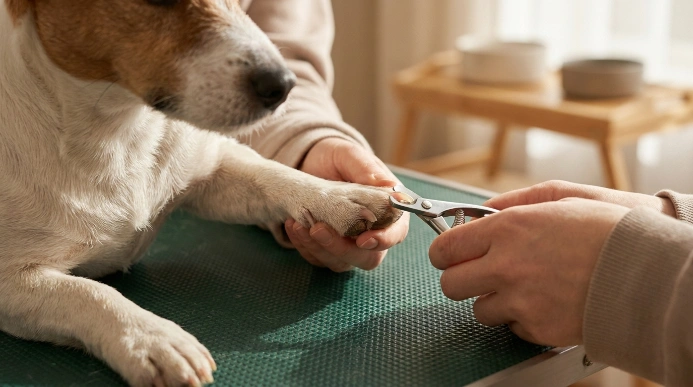
How to Trim Dog Nails: 7 Essential Tips for Safe Trims
You pick up the nail clippers.
Your dog immediately pulls their paw away.
You try again. They move again.
Now you’re worried about cutting too far, your dog is getting suspicious, and a grooming task that should take a few minutes suddenly feels impossible.
You’re not alone.
Learning how to trim dog nails can be intimidating because there’s living tissue inside each nail. Cut too far and you can cause pain and bleeding. Avoid nail trimming entirely, however, and nails can become excessively long, interfere with normal paw placement, snag, break, or even curve toward the paw pads.
The good news is that nail trimming becomes much easier once you understand the anatomy and stop trying to remove too much at once.
Current veterinary guidance from VCA recommends making small, gradual cuts and regularly inspecting the nail as you approach the quick. VCA also emphasizes that fearful dogs should be introduced to nail care gradually rather than forcibly restrained.
Here’s how to approach the job safely.
1. Know When Your Dog’s Nails Are Too Long
You don’t necessarily need a strict calendar reminder.
Look at the nails.
VCA recommends checking whether the nails touch the ground while the dog is standing normally. If they do, they’re likely too long. Another familiar clue is persistent clicking as your dog walks across hard floors.
Many dogs need nail trimming around once a month, although this varies.
Dogs that regularly walk on concrete or other abrasive surfaces may naturally wear their nails down and go longer between trims. Less-active dogs or dogs primarily walking on soft surfaces may need trimming more frequently.
Don’t forget the dewclaws.
Because dewclaws generally don’t contact the ground, normal walking won’t wear them down. They can become excessively long and, in severe cases, curve toward the paw pad.
Make checking every nail part of your complete dog grooming at home guide rather than waiting until the nails become obviously overgrown.
2. Understand the Quick Before Making the First Cut
This is the part that makes many owners nervous.
A dog’s nail isn’t just dead material.
Inside is sensitive living tissue containing nerves and blood vessels known as the quick.
Cut into it and the nail can bleed and hurt.
Merck Veterinary Manual specifically warns that the quick is a blood vessel within the nail and should be avoided during trimming because nicking it causes bleeding and pain.
Light-colored nails
The quick is usually easier to identify in clear or light nails.
You may be able to see a pink area running through the nail.
VCA recommends leaving roughly 2–3 mm between your cut and the visible quick.
Don’t try to cut precisely against it.
Leave yourself a safety margin.
What about black dog nails?
Dark nails are harder because you can’t simply look through the nail and identify the pink quick.
This is where tiny cuts become especially important.
VCA recommends removing only around 1–2 mm at a time from dark nails and repeatedly examining the freshly cut surface.
As you approach the living tissue, the center changes in appearance and texture. VCA’s handling guidance describes the center as becoming less dry and flaky and more shiny as you approach the quick. That’s your signal to stop.
When uncertain, stop early.
Slightly longer nails are better than a painful cut.
3. Get the Right Tools Ready First
Don’t start trimming and then realize the styptic powder is in another room.
Prepare everything before bringing your dog into position.
You’ll generally need:
- Dog nail clippers or grinder
- Styptic powder
- Good lighting
- Appropriate treats
- Non-slip surface
- Optional helper
Use sharp, appropriately sized dog nail clippers.
Dull tools can crush rather than cleanly cut the nail, making the experience uncomfortable.
A nail grinder is another option.
Some dogs that dislike clippers tolerate grinding better, and grinders can create a smooth nail edge. VCA also notes that grinders may reduce the likelihood of suddenly cutting deeply into the quick.
They have their own precautions, though.
Grinding creates heat.
VCA recommends very short contact—roughly one or two seconds at a time—to avoid making the nail uncomfortably hot.
You’ll also need to introduce your dog to the grinder’s sound and vibration gradually.
The best tool isn’t necessarily the most expensive one.
It’s the one you can operate safely and your dog can comfortably tolerate.
4. Trim Tiny Amounts Instead of Making One Big Cut
Trying to finish quickly is where mistakes happen.
Hold the paw comfortably without squeezing excessively.
Separate the nail you’re working on and examine it in good light.
Then remove a small amount from the tip.
Inspect.
Remove another tiny amount if needed.
Inspect again.
With dark nails in particular, this gradual method allows you to watch for changes that indicate you’re getting close to the quick.
VCA recommends taking small 1–2 mm clips rather than making one large cut when the quick isn’t visible.
What angle should you use?
Follow the natural shape of the nail rather than trying to dramatically flatten it.
Your goal isn’t to make the nail as short as physically possible.
It’s to remove excessive length without reaching living tissue.
If your dog’s nails have been neglected for a long time, the quick may extend farther down the nail than you expect.
That means you may not be able to safely achieve ideal nail length in one session.
Regular small trims can be a much better strategy than trying to correct months of growth in one afternoon.
5. Know What to Do If You Cut the Quick
Even experienced people occasionally cut a nail too short.
If it happens, don’t panic.
Your dog may react because it hurts, and the amount of blood can look alarming.
Apply styptic powder to the nail.
VCA recommends styptic powder for controlling minor bleeding from an accidentally cut quick. If styptic powder isn’t available, flour or cornstarch can serve as temporary alternatives.
Merck Veterinary Manual similarly recommends pressure or a clotting aid such as styptic powder, cornstarch, or flour for bleeding nails.
Keep your dog calm while dealing with the bleeding.
Remember that a painful dog may react differently from normal. Even a gentle dog may pull away or snap when something hurts.
When is it more than a minor quick injury?
A simple nick during trimming is different from a nail that has:
- Torn significantly
- Split
- Broken near its base
- Partially detached
- Continued bleeding
- Become extremely painful
Broken nails can expose sensitive living tissue and may require veterinary treatment.
If you’re uncertain about the injury, contact your veterinarian.
6. Don’t Force a Frightened Dog Through the Trim
This is one of the most important nail-care rules.
Your dog doesn’t understand that you’re “just trimming the nails.”
From their perspective, you’re holding a sensitive paw while bringing a strange cutting tool toward it.
Some dogs don’t care.
Others are terrified.
Watch their body language.
Signs that your dog is struggling can include:
- Repeatedly pulling away
- Trembling
- Panting
- Excessive drooling
- Trying to escape
- Growling
- Snapping
If fear is escalating, stop.
VCA’s veterinary behavior guidance warns that continuing when a dog is showing fearful or reluctant body language can make their fear worse. Forced restraint can similarly increase the negative association with nail care.
Don’t punish growling.
A growl is information.
Your dog is telling you that they’re uncomfortable.
Punishing that warning doesn’t make the underlying fear disappear.
You don’t have to trim every nail at once
This simple idea can transform nail care.
Trim one nail.
Reward your dog.
Stop.
Tomorrow, perhaps trim another.
VCA recommends breaking the process into very small steps and progressing only when the dog remains comfortable.
There’s no prize for completing four paws in one sitting.
The long-term goal is a dog who can calmly participate in nail care.
7. Teach Your Dog That Nail Trimming Is Safe
The easiest dog to groom is one who has learned that handling isn’t frightening.
Ideally, start before you actually need to cut anything.
Touch your dog’s shoulder.
Reward calm behavior.
Move your hand gradually down the leg.
Reward.
Touch the paw.
Reward.
Handle individual toes.
Reward.
Then introduce the nail clippers without using them.
VCA recommends this type of gradual desensitization and counterconditioning, where the process is broken into manageable steps and each comfortable interaction is paired with something the dog values.
With a grinder, introduce the sound separately before putting the tool against a nail.
The process might seem slow.
But spending several short sessions building confidence can save years of stressful nail-trimming battles.
Don’t trick a fearful dog
There’s an important difference between using treats as positive reinforcement and distracting a terrified dog while secretly cutting a nail.
VCA’s behavior guidance specifically cautions against tricking fearful dogs with food and then unexpectedly trimming their nails, because doing so can damage trust.
Let your dog understand what’s happening.
Reward cooperation rather than deception.
Clippers vs. Grinder: Which Is Better?
Both can work.
Clippers
Advantages:
Fast and quiet.
A single small cut removes nail immediately.
No vibration.
Challenges:
It’s possible to remove too much at once.
Some dogs dislike the pressure or clipping sensation.
Grinder
Advantages:
Allows gradual removal.
Produces smoother edges.
Some clipper-sensitive dogs prefer it.
Challenges:
Noise and vibration can frighten some dogs.
The rotating tool can catch long fur.
Holding it against the nail too long generates heat.
There’s no universally superior option.
Your technique and your dog’s comfort matter more.
How Do You Trim Very Overgrown Dog Nails?
This is where patience becomes especially important.
When nails remain long for an extended period, the quick may extend farther toward the tip.
Simply cutting the nail back to an ideal length isn’t safe if living tissue occupies that space.
Instead, the nails may need to be shortened gradually through repeated trims.
If they’re severely overgrown, curling, affecting the paw, or you’re unable to determine where it’s safe to cut, use a professional groomer or veterinarian.
Don’t make an aggressive cut just because an online photograph shows a shorter nail.
Every dog’s quick is different.
Can Walking on Pavement Replace Nail Trimming?
Sometimes it helps.
It doesn’t reliably replace nail care.
Dogs regularly walking on hard surfaces may naturally wear their nails and therefore require less frequent trimming.
But different nails can wear at different rates.
Dewclaws won’t receive the same ground contact.
Your dog’s gait, exercise, environment, and nail growth all influence the result.
Check the actual nails instead of assuming your daily walk is taking care of them.
Should Puppies Have Their Nails Trimmed?
Yes, when needed—and puppyhood is an excellent time to introduce positive paw handling.
Don’t wait until your dog weighs 80 pounds and has never allowed anyone to touch their feet.
Make paw handling an ordinary part of life.
Briefly touch the paws.
Handle individual toes.
Introduce grooming tools.
Reward relaxed behavior.
VCA recommends teaching puppies the separate skills involved in nail care, including accepting paw handling and becoming comfortable with the sight, sound, and touch of clippers or grinders.
Early positive experiences can make adult grooming significantly easier.
When Should a Professional Trim Your Dog’s Nails?
There’s no shame in outsourcing nail trimming.
Consider a groomer or veterinarian when:
- You can’t identify where it’s safe to cut
- The nails are severely overgrown
- Your dog becomes highly fearful
- Your dog may bite
- A nail is damaged or painful
- Your dog’s medical condition makes handling difficult
- You’re simply uncomfortable doing it yourself
VCA notes that veterinary clinics and professional groomers can perform nail trims, and veterinary teams may have additional options for dogs that are extremely distressed.
The goal is safe nail maintenance, not proving you can do every grooming task yourself.
Frequently Asked Questions
How often should I trim my dog’s nails?
Many dogs need nail trimming roughly monthly, although some need it every few weeks and others go longer because walking on hard surfaces naturally wears their nails. Check whether the nails touch the floor or consistently click on hard surfaces.
How do I know where the quick is on black nails?
You usually can’t see it through a black nail. Remove tiny amounts and inspect the cut surface after each clip. Stop as the center begins changing from dry and flaky toward a smoother, shinier appearance.
What happens if I cut the quick?
It can cause pain and bleeding. Apply styptic powder and keep your dog calm. Cornstarch or flour can be used temporarily when styptic powder isn’t available. Persistent or serious bleeding requires veterinary advice.
Is a nail grinder safer than clippers?
A grinder allows gradual nail removal and may reduce the chance of suddenly cutting deeply into the quick, but it still requires careful technique. Avoid prolonged contact because friction can heat the nail.
Why does my dog hate having their nails trimmed?
Dogs may dislike paw restraint, pressure from clippers, grinder noise, or may remember a previous painful experience. Gradual positive training is preferable to forcing a frightened dog through the procedure.
PetCareRoutine Perspective
Learning how to trim dog nails isn’t about becoming fast with a pair of clippers.
It’s about becoming careful.
Check your dog’s nails regularly rather than waiting until they’re badly overgrown. Learn where the quick is. Use sharp, appropriate equipment. Remove tiny amounts and stop whenever you’re uncertain.
But pay just as much attention to the dog attached to those nails.
If they’re frightened, slow down.
One calmly trimmed nail is better than completing four paws while your dog struggles in panic.
Over time, those short positive experiences can turn nail care from something both of you dread into an ordinary part of your dog’s healthy grooming routine.
And if you’re not comfortable doing it yourself?
Use a groomer or veterinarian.
Safe grooming matters much more than who holds the clippers.
Continue reading more
https://vcahospitals.com/know-your-pet/how-to-trim-a-dogs-nails