
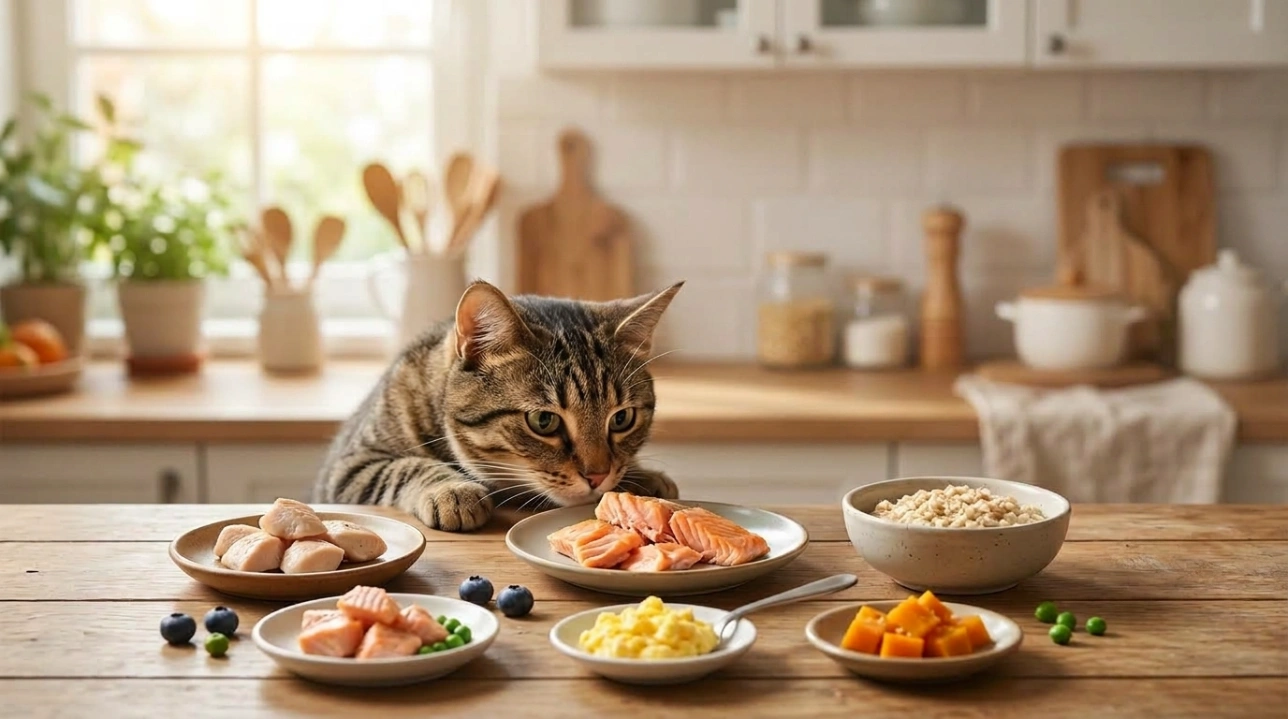
It is hard to resist a cat who appears at the kitchen counter the moment you open a container of food. A tiny taste may seem harmless, but cats do not process every human food the way people do. Some simple foods can work as occasional treats, while others are unsafe or add calories without providing useful nutrition.
So, what human food can cats eat? The safest approach is to treat human food as an occasional extra rather than a replacement for a complete cat diet. Cats are obligate carnivores and need specific nutrients that are supplied by a properly formulated cat food. For more on age-appropriate feeding, see our kitten feeding guide. Cornell University College of Veterinary Medicine explains that treats should generally remain a small part of a cat’s daily intake, while the main diet should provide complete and balanced nutrition. Cornell’s feline nutrition guide provides more detail on choosing an appropriate diet.
9 Human Foods Cats Can Usually Eat as Occasional Treats
The word “usually” matters. A food that is safe for a healthy adult cat may not be appropriate for a kitten, a cat with kidney disease, diabetes, food allergies, digestive problems, or another condition. If your cat is already refusing meals, our guide to why a cat may stop eating covers an important warning sign. Preparation matters too: plain, cooked, unseasoned food is very different from a dish containing sauces, spices, salt, butter, onions, or garlic.
1. Plain cooked chicken
Chicken is one of the simplest human-food treats for cats. Offer a small amount of fully cooked, boneless meat with no seasoning, sauce, onion, garlic, or added salt. Remove skin and visible excess fat if the piece is particularly fatty.
Think of chicken as a treat, not a complete meal. A cat’s nutritional needs extend far beyond protein, so regularly replacing balanced cat food with plain meat can create nutritional gaps.
2. Plain cooked turkey
Unseasoned cooked turkey can also be offered in small portions. Choose plain meat rather than deli turkey, smoked turkey, gravy-covered turkey, or holiday leftovers. Processed meats often contain much more sodium and may include seasonings that are unsuitable for cats.
A useful kitchen rule is simple: if you would describe the food as “seasoned,” it probably should not go into your cat’s treat bowl.
3. Fully cooked egg
A small amount of plain, fully cooked egg can be an occasional treat for many healthy cats. Keep it simple and avoid salt, butter, sauces, and seasoning. Scrambled egg is only a reasonable option when it is cooked without ingredients that may cause problems.
Egg should not become a major part of the diet. Cats need a carefully balanced combination of nutrients, not just individual high-protein foods.
4. Plain cooked fish
Some cats enjoy plain cooked fish, but preparation makes the difference. Choose fully cooked fish with bones removed and without salt, oil-heavy sauces, spices, or seasoning. A tiny portion can be used as an occasional treat.
Do not assume that every fish product sold for people is suitable for cats. Cornell notes that some cats fed canned fish products intended for humans have developed serious neurological problems. That is a good reason to keep human fish products occasional and choose a balanced cat food as the foundation of the diet.
5. Plain cooked pumpkin
Plain pumpkin can be offered in a small amount if your cat tolerates it. Use plain cooked pumpkin or a product that contains pumpkin alone, not sweetened pie filling or a seasoned pumpkin dish.
Pumpkin is often discussed in connection with digestive health, but it should not be treated as a cure for diarrhea, constipation, vomiting, or other symptoms. If digestive problems persist or your cat seems unwell, veterinary advice is more important than adding another food. Persistent loose stools are covered in our guide to cat diarrhea and when to seek veterinary care.
6. Plain cooked carrots
Small pieces of soft, cooked carrot can be an occasional treat for some cats. Cut them into appropriately small pieces and serve them plain. Because cats have different preferences and digestive tolerances, introduce any new food gradually rather than giving a large portion at once.
Carrots are not nutritionally necessary for cats. If your cat ignores them, there is no reason to force the issue.
7. Plain cooked green beans
Small amounts of plain cooked green beans can also be offered to a cat that enjoys them. Avoid versions prepared with butter, garlic, onion, sauces, or heavy seasoning.
Vegetables should remain optional extras. Cats do not need a vegetable-heavy diet, and adding more plant foods does not automatically make a cat’s diet healthier.
8. Small pieces of plain cooked sweet potato
Plain, thoroughly cooked sweet potato can be offered in a very small amount. Remove the skin if it is tough, mash or cut the cooked portion into tiny pieces, and skip butter, sugar, salt, spices, and toppings.
Because sweet potato supplies carbohydrates rather than being an essential feline nutrient source, it is better viewed as an occasional novelty than a routine part of a cat’s meals.
9. A tiny amount of plain apple flesh
Some cats can tolerate a small piece of plain apple flesh. Remove the seeds and core, cut the flesh into a very small piece, and never give your cat a seasoned apple dessert or sweetened preparation.
There is also no nutritional reason to make fruit a regular part of a cat’s diet. Many cats simply have no interest in it, which is perfectly fine.
Human Foods Cats Should Avoid
The bigger safety lesson is that “human food” is not one category. A plain ingredient can be very different from a finished human dish.
Cornell’s feline health guidance lists several foods that should be kept away from cats, including grapes, raisins, onions, avocados, chocolate, and foods containing xylitol. Cornell’s cat-hazard guide also warns that human medications can be dangerous to cats.
- Chocolate: Keep it completely away from cats.
- Onions and garlic: Avoid foods containing these ingredients, including many sauces, broths, gravies, and seasoned meats.
- Grapes and raisins: Do not offer them as treats.
- Xylitol-containing foods: Avoid products containing this sweetener.
- Alcohol: Never give alcoholic drinks or foods containing alcohol intentionally.
- Heavily seasoned foods: Seasonings, sauces, salt, and rich ingredients can turn an otherwise simple food into a poor choice.
- Milk and dairy: Many cats do not tolerate dairy well, so milk is not a necessary treat.
- Raw meat or raw eggs: Raw foods carry food-safety concerns and should not be assumed to be safer simply because cats are carnivores.
How Much Human Food Can a Cat Have?
Portion size is where many well-intentioned owners go wrong. A treat that looks tiny to a person can represent a meaningful amount of calories for a small cat.
Cornell recommends keeping treats to roughly 10% to 15% of a cat’s daily caloric intake. That does not mean you should calculate calories for every bite, but it gives useful perspective: treats should stay small enough that the cat’s complete and balanced main diet remains the nutritional foundation.
For a cat that is overweight, has diabetes, has food allergies, or follows a prescription diet, even ordinary treats may need to be restricted. Ask your veterinarian before introducing human foods if your cat has a medical condition or a prescribed diet.
A Simple Safety Check Before Sharing Your Food
Before handing your cat a bite from your plate, run through four questions:
- Is the ingredient known to be safe for cats?
- Is it plain and unseasoned?
- Is the portion genuinely small?
- Does my cat have a health condition or special diet that changes the answer?
If you cannot answer the first question confidently, do not improvise. Check with a veterinarian or a reliable veterinary source instead.
Human Food Should Never Replace Complete Cat Food
One of the easiest mistakes is assuming that a collection of healthy-looking ingredients can replace commercial cat food. It cannot. Cats require specific nutrients, including taurine and preformed vitamin A, in appropriate amounts and ratios.
AAFCO explains that pet foods should be selected according to the animal’s species, life stage, and condition, and that the nutritional adequacy statement is an important part of evaluating whether a food is complete and balanced. AAFCO’s guide to selecting pet food explains what owners should look for on the label.
This is why a few pieces of cooked chicken can be a treat while a bowl of chicken alone is not an appropriate long-term cat diet.
What If Your Cat Eats Something Unsafe?
If your cat eats a potentially toxic food, do not wait for symptoms before seeking professional guidance. The appropriate response depends on what was eaten, how much was consumed, and your cat’s size and health.
Do not give human medications or attempt home treatments unless a veterinarian or animal poison professional specifically instructs you to do so. Cornell specifically warns that human medications can be acutely toxic to cats.
If your cat develops repeated vomiting, severe weakness, breathing difficulty, seizures, collapse, significant lethargy, or other concerning symptoms after eating something questionable, seek urgent veterinary care.
FAQ: What Human Food Can Cats Eat?
Can cats eat cooked chicken?
Yes, plain fully cooked chicken can be an occasional treat for many healthy cats. Keep it boneless, unseasoned, and in a small portion.
Can cats eat eggs?
Small amounts of fully cooked, plain egg can be offered occasionally. Avoid raw egg and preparations containing salt, butter, sauces, onion, garlic, or other seasonings.
Can cats eat vegetables?
Some cats can tolerate small amounts of plain cooked vegetables such as carrots or green beans, but vegetables are not required to make a cat’s diet complete and balanced.
Can cats eat fruit?
Some fruits can be offered in tiny amounts, but fruit is optional and should never replace a nutritionally complete cat diet. Avoid toxic foods such as grapes and raisins.
Can cats drink milk?
Milk is not necessary for adult cats, and many cats have difficulty digesting dairy. Fresh water should be the normal drink available to your cat.
PetCareRoutine Perspective
The safest way to think about human food for cats is not “Which foods from my kitchen are healthy?” but “Which tiny extras can I offer without disrupting a complete feline diet?” For another everyday feline-care topic, see our guide explaining how many teeth cats have and what they do. Plain cooked meats and a few other simple foods may work as occasional treats, but ingredients, preparation, portion size, and your cat’s individual health all matter.
When in doubt, keep the main diet complete and balanced, keep treats small, and avoid foods known to be toxic. If your cat has a medical condition or suddenly develops digestive symptoms after eating something unusual, a veterinarian should guide the next step.