
Cat Peeing Outside Litter Box? 7 Alarming Causes
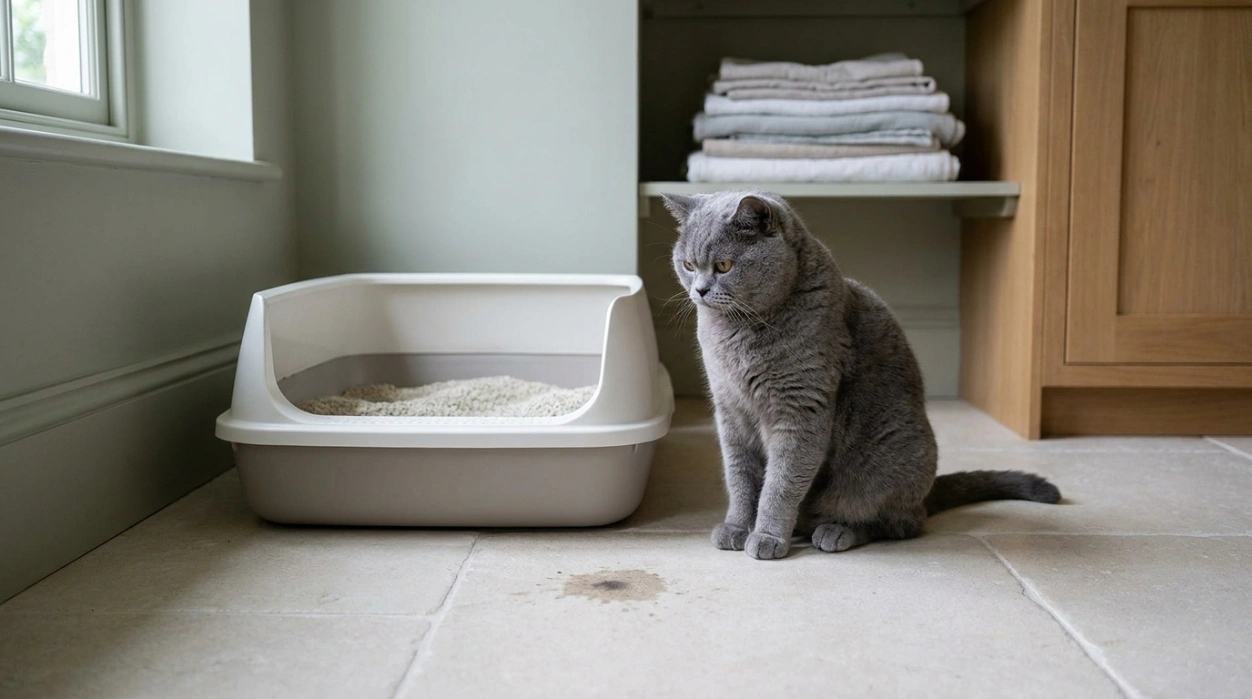
You discover a wet patch on the rug. Then another appears beside the litter box. A few days later, your cat urinates on the bed.
It is frustrating—and it is easy to assume your cat is being stubborn or deliberately misbehaving.
But when a cat starts peeing outside the litter box, punishment is one of the least helpful responses.
Cats can stop using their litter boxes because of urinary pain, illness, stress, litter preferences, an unsuitable box, conflict with another cat, or difficulty physically reaching the box.
The Feline Veterinary Medical Association’s house-soiling guidelines specifically emphasize that this behavior is not caused by spite or anger toward the owner. The goal is to identify which physical, medical, social, or environmental need isn’t being met.
And sometimes, the cause is urgent.
Cornell University’s Feline Health Center warns that cats experiencing a urethral obstruction may repeatedly attempt to urinate while producing little or no urine. A urinary obstruction is an absolute veterinary emergency.
So instead of asking, “How do I make my cat stop?”
Start with:
Why has my cat’s behavior changed?
Here are seven important possibilities.
1. A Urinary Problem May Make the Litter Box Painful
Medical causes should be considered first, particularly when a previously reliable cat suddenly starts having accidents.
Feline lower urinary tract disease, or FLUTD, isn’t one specific illness. It describes several disorders involving the bladder and urethra.
Cornell lists common lower urinary tract signs including painful or difficult urination, frequent attempts to urinate, crying while urinating, blood in the urine, excessive genital licking, and urination outside the litter box.
One possible condition is feline idiopathic cystitis, or FIC.
FIC involves bladder inflammation without another identifiable underlying disease after diagnostic investigation. Stress appears to play an important role in many affected cats.
Urinary stones can cause similar symptoms.
The problem is that owners can’t reliably determine the cause simply by watching their cat.
That’s why a sudden litter-box change deserves veterinary attention rather than an assumption that it is behavioral.
Watch especially closely for male cats
Male cats have narrower urethras and can develop urinary obstruction.
If your cat repeatedly enters the litter box, strains, cries, produces only tiny amounts of urine—or cannot urinate at all—seek emergency veterinary care immediately.
Do not wait overnight to see whether the problem improves.
2. The Litter Box May Be Too Dirty
Your cat’s standards of cleanliness may be considerably higher than yours.
A litter box that looks acceptable to us may already be unpleasant to a cat with an extremely sensitive sense of smell.
Some cats tolerate a little waste. Others begin looking for another bathroom almost immediately.
Cornell recommends keeping litter boxes clean, while feline house-soiling guidance recommends removing waste at least daily.
In multi-cat homes, cleanliness becomes even more important because several cats may be using the same resources.
Scoop boxes at least once daily and more often when needed.
Periodically empty and wash the box using mild soap and hot water. Avoid turning the litter box into a perfume counter with heavily fragranced cleaners.
Strong odors that smell “fresh” to you may make the box less appealing to your cat.
And avoid ammonia-based cleaning products around toileting areas. FelineVMA guidance specifically cautions against them when cleaning house-soiling areas.
3. Your Cat May Dislike the Litter
Changing litter can seem insignificant.
To your cat, it may completely transform the bathroom.
Texture, fragrance, dust, depth and even how the litter feels under the paws can influence preference.
Many cats prefer soft, unscented clumping litter, while aromatic litter, deodorizers and some liners can be less appealing.
Think about when the accidents started.
Did you recently switch brands?
Move from fine litter to large pellets?
Buy a strongly scented product?
Add a litter deodorizer?
If the timing matches, your cat may be communicating a preference rather than developing a mysterious behavioral problem.
When testing alternatives, avoid changing everything simultaneously. Providing separate boxes with different litter options can help reveal what your cat actually prefers.
But remember: a litter change doesn’t rule out illness.
A cat experiencing urinary pain can begin avoiding the litter box at exactly the same time you happen to change litter.
Medical problems should still be considered when house-soiling begins suddenly.
4. The Box May Be Too Small or Difficult to Enter
A beautiful designer litter box isn’t useful if your cat hates using it.
Size matters.
Your cat needs enough room to enter, turn around, dig, posture comfortably, and leave without feeling trapped.
Feline-friendly guidance recommends boxes large enough for cats to move and eliminate comfortably; one commonly used recommendation is approximately 1.5 times the cat’s length from nose to the base of the tail.
Accessibility matters too.
A young athletic cat may happily jump into a tall-sided box.
A senior cat with arthritis may not.
If an older cat suddenly begins urinating beside rather than inside the box, ask whether physically climbing into it has become uncomfortable.
Cornell notes that age-related conditions affecting mobility can interfere with a cat’s ability to reach or use the litter box appropriately.
Consider a larger box with a lower entrance for cats with limited mobility.
Placement is equally important. An elderly cat shouldn’t have to cross the house and climb a flight of stairs every time nature calls.
5. You May Not Have Enough Litter Boxes
One litter box for several cats can create problems even when you keep it spotless.
A widely recommended guideline is:
One litter box per cat, plus one additional box.
So two cats would ideally have access to three boxes.
Cornell includes this recommendation in its guidance for reducing lower urinary tract problems, and feline house-soiling guidance recommends distributing those boxes across different areas rather than grouping them together.
That last detail matters.
Three boxes lined up side by side may effectively function as one toileting location from your cats’ perspective.
Spread them around the home.
In a multi-story house, consider providing a box on each level, especially when you have kittens, senior cats, or cats with mobility limitations.
Multiple locations also prevent one cat from controlling access to every toilet.
Which leads to another common problem.
6. Stress or Conflict With Another Cat Can Cause House-Soiling
Multi-cat households aren’t always as harmonious as they appear.
Two cats may never have a dramatic fight but still experience tension.
One may stare at another.
Block a hallway.
Guard access to food.
Wait outside the litter box.
Chase the other cat when it tries to leave.
A less confident cat may decide that using the litter box isn’t worth the risk.
FelineVMA guidance specifically notes that boxes should be positioned so another cat cannot block access or trap a cat while toileting.
Stress doesn’t require another cat, either.
Moving house, renovation, unfamiliar visitors, a new baby, schedule changes, outdoor cats appearing through windows, or other environmental disruptions can affect sensitive cats.
Stress is particularly relevant because it can also contribute to feline idiopathic cystitis.
Cornell identifies environmental changes, altered feeding schedules and changes in the number of animals in a household as potential stressors associated with FIC.
Give cats multiple safe resting places, hiding areas, elevated spaces, scratching opportunities, play, food and water stations, and toileting locations.
The objective isn’t simply to provide “more stuff.”
It is to prevent one resource or location from becoming a point of conflict.
7. Other Medical Conditions Can Increase Urination
Not every litter-box problem originates in the bladder.
Diseases that cause a cat to produce more urine can make accidents more likely.
Cornell identifies kidney disease, thyroid disease and diabetes among medical conditions that may contribute to litter-box problems because affected cats can drink and urinate more frequently.
This is why changes in drinking behavior matter.
If your cat suddenly seems permanently attached to the water bowl, read our guide on how much water a cat should drink.
Increased thirst combined with increased urination deserves veterinary attention.
Other symptoms matter too.
Has your cat lost weight?
Stopped eating normally?
Started vomiting?
Become lethargic?
If appetite has also fallen, the pattern deserves additional attention rather than being treated solely as a litter-box problem.
Cats experiencing digestive problems may also eliminate outside the box, particularly when urgency prevents them from reaching it. If stool changes are occurring too, our guide to cat diarrhea explains the warning signs that deserve veterinary evaluation.
Peeing or Spraying? The Difference Matters
Not every urine deposit outside the box represents ordinary urination.
Cats also urine-mark.
The pattern can provide clues.
A cat emptying its bladder usually squats and leaves a relatively larger puddle on a horizontal surface.
A spraying cat more commonly stands, raises its tail, and deposits a smaller amount of urine onto a vertical surface.
Marking is communication.
Cats use scent as part of how they interact with their environment. Changes in social relationships, territory and stress can increase marking behavior.
However, don’t assume spraying automatically means there is no medical problem.
A veterinary assessment remains worthwhile when urine behavior suddenly changes.
Why Is My Cat Peeing on My Bed?
Beds are soft, absorbent and smell strongly like their owners.
A cat urinating there isn’t necessarily “getting revenge.”
Your bed may simply feel safe, comfortable, or preferable to a litter box that has become unpleasant.
Cornell notes that cats with litter-box aversion may eliminate on soft surfaces such as carpets, clothing or beds.
First rule out medical causes.
Then evaluate the litter box itself, household stress, other pets and environmental changes.
Don’t punish your cat or carry them to the urine spot to scold them.
That doesn’t explain what you want them to do differently and may increase stress—the very thing contributing to the problem.
Why Is My Cat Peeing Right Next to the Litter Box?
This pattern can be especially confusing.
The cat clearly knows where the bathroom is, so why miss it by inches?
Several explanations are possible.
The box might be too small, dirty, difficult to enter, unpleasant underfoot, or associated with pain.
A senior cat may reach the box but struggle to climb over its sides.
A cat experiencing urinary urgency may not make it fully inside.
Pay attention to whether the cat is repeatedly entering the box, straining, vocalizing or producing unusually small amounts of urine.
Those signs raise the possibility of urinary disease.
How to Stop a Cat From Peeing Outside the Litter Box
The solution depends on the cause.
Start with veterinary evaluation when the behavior is new or unexplained.
Once medical problems have been addressed or ruled out, optimize the litter-box environment.
Use adequately sized boxes in quiet, accessible locations. Provide enough boxes for the household. Scoop frequently. Try an unscented litter your cat accepts.
Separate boxes rather than clustering all of them together.
Clean accident areas thoroughly so residual odor doesn’t continue attracting your cat to the same spot. Use an appropriate enzymatic cleaner and follow its directions.
Most importantly:
Do not punish your cat.
FelineVMA guidance advises against punishment and aversive methods because they can increase distress and make unwanted behavior worse.
Solve the reason for the behavior instead.
Can Dehydration Affect Urinary Health?
Hydration is important to feline urinary health.
Cats naturally have relatively concentrated urine, and encouraging appropriate water intake is often part of managing certain urinary conditions.
Provide clean fresh water at all times.
Some cats prefer multiple bowls in different locations. Others drink more readily from fountains.
Wet food can also contribute substantially to total water intake, although diet changes for a cat with diagnosed urinary disease should be discussed with your veterinarian.
For a deeper explanation, see how much water should a cat drink?.
Don’t add urinary supplements or change to a therapeutic diet simply because your cat had an accident. Different urinary disorders require different management.
Diagnosis comes first.
When Is Peeing Outside the Litter Box an Emergency?
This is the section every cat owner should remember.
A cat repeatedly attempting to urinate but producing little or no urine may have a urethral obstruction.
Cornell describes urethral obstruction as an absolute emergency requiring immediate veterinary treatment.
Emergency warning signs can include:
- repeated unsuccessful trips to the litter box
- straining without producing urine
- crying while attempting to urinate
- increasing distress
- vomiting
- weakness or lethargy
- painful abdomen
- collapse
Male cats are particularly at risk of obstruction.
Do not assume your cat is constipated simply because they’re straining in the litter box. Cornell notes that urinary straining can sometimes be mistaken for constipation.
If you aren’t sure whether your cat can urinate, contact a veterinarian immediately.
Frequently Asked Questions
Why is my cat suddenly peeing outside the litter box?
A sudden change can result from urinary disease, pain, increased urine production, stress, litter-box aversion, conflict with another cat, or changes to the litter or environment. A veterinary examination should be an early step, especially when the behavior is new.
Is my cat peeing outside the box because they’re angry?
Probably not. Veterinary house-soiling guidelines specifically discourage interpreting the behavior as spite or anger. Cats usually have medical, environmental, social or litter-box-related reasons for changing where they eliminate.
How many litter boxes should I have?
A common recommendation for multi-cat households is one box per cat plus one additional box, distributed in separate locations.
What type of litter do cats prefer?
Preferences vary, but many cats favor soft, unscented clumping litter. Strong fragrances, dusty litter and deodorizing products can be undesirable to some cats.
Should I punish my cat for peeing outside the box?
No. Punishment doesn’t treat urinary pain, stress, box aversion or environmental problems and can increase fear and distress.
Why is my older cat suddenly having accidents?
Older cats may develop kidney disease, diabetes, thyroid problems, arthritis, cognitive changes or other conditions that affect urination or their ability to reach the box. Cornell also identifies house-soiling as one possible sign associated with feline cognitive dysfunction. A veterinary examination is appropriate for a new behavior change in a senior cat.
PetCareRoutine Perspective
A cat peeing outside the litter box can be frustrating, but treating the behavior as deliberate disobedience sends you in the wrong direction.
Instead, treat it as information.
Your cat may be telling you that urination hurts, the box feels unsafe, another cat is blocking access, the litter is unpleasant, getting into the box has become physically difficult, or something about their health has changed.
Start with the cat, not the carpet.
Rule out medical problems. Make the litter-box environment genuinely cat-friendly. Reduce competition and stress. Clean accidents properly without punishment.
And remember the most important exception to the wait-and-see approach: a cat repeatedly straining while producing little or no urine needs emergency veterinary care.
Once you identify why the behavior changed, you have a much better chance of helping your cat return to normal litter-box habits.
Source: https://catvets.com/resource/aafp-isfm-house-soiling-guidelines/